
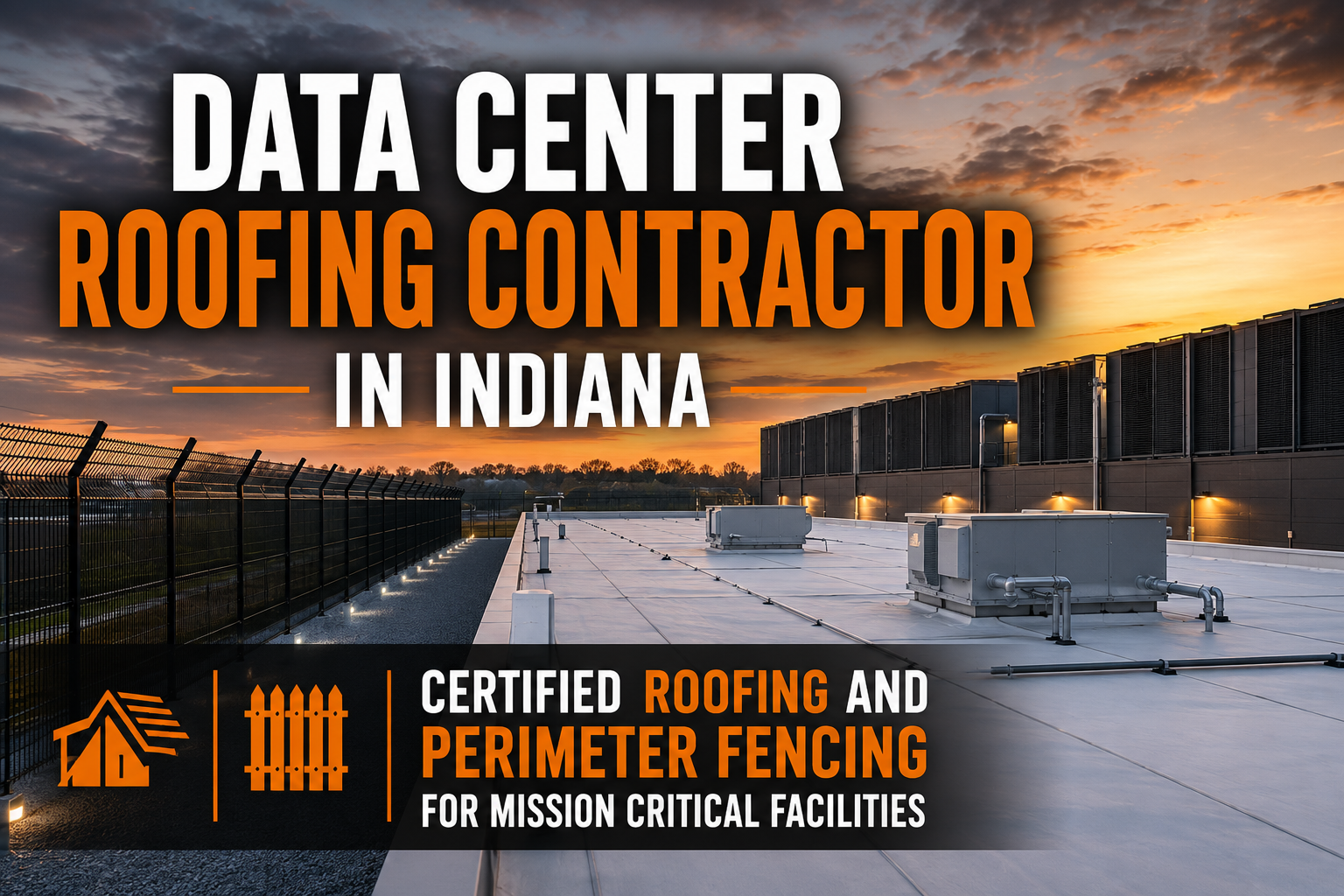
Finding a qualified data center roofing contractor in Indiana requires more than finding a contractor who does commercial roofing. Furthermore, data centers operate under conditions where roofing and perimeter fencing failures have consequences that dwarf the cost of any construction project — operational downtime, equipment damage, compliance violations, and compromised physical security boundaries that affect SOC 2, NIST, and ISO 27001 audit outcomes. Guarantee Roofing and Fence has completed roofing and perimeter fencing installations for data center facilities across Central Indiana, bringing Duro-Last Top 3% national certification and 107 years of Indiana craftsmanship to every mission critical project we undertake.
In this guide we cover exactly what data center facility managers and infrastructure directors need to know about roofing and perimeter fencing requirements — why certification matters, what compliance frameworks require, and what to look for when evaluating a contractor for your Indiana data center facility.
Why Data Centers Require a Specialized Roofing Contractor in Indiana
The Cost of Roof Failure at a Mission Critical Facility
A roof leak on a standard commercial building causes interior damage and business disruption. Furthermore, a roof leak at a data center causes equipment damage, operational downtime, and potential data loss — each with costs that multiply the value of any roofing project by orders of magnitude. Additionally, insurance and compliance documentation requirements for data center facilities are significantly more demanding than standard commercial properties, requiring written condition reports, maintenance records, and certified installation documentation that most roofing contractors cannot provide.
The distinction between a capable commercial roofer and a certified data center roofing contractor in Indiana is not marketing language. Furthermore, it is a substantive difference in installation standards, quality verification processes, and accountability mechanisms that compliance auditors specifically evaluate.
What Duro-Last Top 3% Certification Actually Means
Guarantee holds Duro-Last’s Top 3% national certification — earned through independently inspected installation quality that fewer than 3% of contractors nationally achieve. Furthermore, Duro-Last independently inspects every installation before issuing warranty coverage, meaning the Top 3% designation reflects a documented track record of inspections passed at the highest quality tier — not a purchased credential or a training certificate.
For data center facility managers evaluating contractors, this distinction is critical. Additionally, a Duro-Last certified installation carries manufacturer warranty coverage of up to 20 years covering both materials and workmanship — protection that non-certified installations cannot access regardless of how experienced the contractor claims to be. Furthermore, you can verify our Duro-Last certification directly on the Duro-Last contractor locator rather than relying on our representation of it.
Data Center Roofing Requirements — What Facility Managers Need to Know
Why Membrane Roofing Systems Dominate Data Center Applications
Data centers almost universally specify single-ply membrane roofing systems for flat and low-slope roof applications. Furthermore, membrane systems offer the zero-tolerance leak performance that mission critical infrastructure requires in ways that conventional built-up roofing cannot match.
Duro-Last PVC membrane specifically offers significant advantages for data center applications. Factory-fabricated seams — where each installation is custom-measured and the majority of seams are welded under controlled factory conditions — eliminate the field-welded seam failures that cause most membrane roofing leaks in conventional TPO and EPDM installations. Furthermore, the white reflective surface reduces cooling loads on HVAC systems already under significant demand in a server-dense environment. Additionally, the system’s chemical resistance makes it compatible with the full range of HVAC condensate and equipment-related exposures common on data center rooftops.
Preventative Maintenance and Compliance Documentation
Data center facilities require documented maintenance records that standard commercial properties rarely demand. Furthermore, compliance frameworks including SOC 2 and ISO 27001 require evidence of regular physical infrastructure assessments — which extends to the building envelope including the roof system. Additionally, lenders, investors, and colocation customers increasingly require documented roof condition reports as part of facility due diligence.
Guarantee provides scheduled preventative maintenance programs for Indiana data center facilities including semi-annual inspections, written condition reports with photographs, and maintenance documentation suitable for compliance audit purposes. Furthermore, program participants receive priority emergency response scheduling — critical for a facility where a roof event requires immediate professional response regardless of time of day. Learn more about our complete commercial roofing and data center services here.
Data Center Perimeter Fencing — What Compliance Requires
Why Perimeter Fencing Is a Compliance Requirement — Not a Preference
<cite index=”24-1″>Data center perimeter protection refers to the layered physical security measures that safeguard a facility’s outer boundary, preventing threats from reaching critical infrastructure. A clearly marked and secured perimeter supports compliance with frameworks such as SOC 2 and ISO 27001, which both require documented physical security boundaries.</cite> Furthermore, <cite index=”26-1″>data center physical security is a compliance requirement with SOC 2, ISO 27001, PCI DSS, and HIPAA certification implications — not an operational choice</cite> — which means perimeter fencing is not an optional line item for facilities operating under these frameworks.
<cite index=”29-1″>Physical barriers like fences, turnstiles, locked doors, cages, and server cabinets provide the first line of defense</cite> in a layered physical security architecture. Additionally, <cite index=”23-1″>SOC 2 physical security requirements specifically include perimeter security such as fencing and gates, access controls to limit who can enter each facility, and surveillance and monitoring systems to detect and respond to unauthorized access</cite>. Therefore, a data center facility without a properly installed, maintained, and documented perimeter fence faces direct compliance risk at audit time.
For a complete overview of what NIST physical access control guidelines require for data center perimeter security — including controlled barriers, entry points, and screening measures — the NIST SP 800-53 publication provides the authoritative framework reference.
Fencing Types for Data Center Perimeter Applications
<cite index=”30-1″>Physical infrastructure is a key factor in data center security. Whenever possible, a sturdy and tall fence or wall around the perimeter of the facility should be installed. This can be augmented by crash-proof barriers, berms, landscaping designed to facilitate security, and video surveillance with 24/7 monitoring. For example, CoreSite colocation facilities are secured by eight-foot perimeter fencing.</cite>
Guarantee installs the following perimeter fencing systems for Indiana data center facilities:
High-security chain link — galvanized or vinyl-coated chain link at heights of 8 feet or more with barbed wire or razor wire topping provides a cost-effective deterrent perimeter that meets minimum physical security requirements for most compliance frameworks. Furthermore, chain link’s visibility allows surveillance camera coverage of the full fence line without obstruction.
Ornamental steel and anti-climb fencing — steel palisade and ornamental steel systems with pointed or hooked tops resist climbing and forced entry more effectively than standard chain link. Furthermore, these systems suit data center facilities where aesthetic requirements or neighboring property considerations make standard chain link less appropriate.
Double gate and airlock entry systems — controlled entry points with self-closing, self-latching gate hardware and double-gate airlock configurations prevent tailgating and unauthorized vehicle access. Additionally, gate hardware rated for continuous operation suits 24-hour staffed facilities without the maintenance failures that lighter-duty residential hardware develops under heavy use.
Perimeter Fence Inspection and Documentation
Compliance auditors evaluating physical security controls specifically review perimeter fence condition, gate hardware function, and documented maintenance history. Furthermore, <cite index=”24-1″>facility managers should schedule formal perimeter audits at least twice per year to identify emerging weaknesses, such as fence gaps, lighting failures, or camera blind spots.</cite> Additionally, written inspection reports documenting fence integrity, gate function, and any identified vulnerabilities provide the audit evidence that compliance frameworks require.
Guarantee provides scheduled perimeter fence inspection programs for Indiana data center facilities with written condition reports suitable for compliance documentation. Furthermore, our inspection reports identify specific sections, gate hardware, and post conditions — not a generic pass or fail assessment — giving your compliance team the granular evidence that SOC 2 and NIST auditors specifically look for.
Data Center Roofing Contractor Indiana — What to Look For When Evaluating Contractors
Manufacturer Certification Verification
The most meaningful credential a data center roofing contractor in Indiana can hold is manufacturer certification verified independently rather than self-reported. Furthermore, Duro-Last’s Top 3% certification requires passing independent field inspections on completed installations — it cannot be purchased or obtained through training alone.
Ask any roofing contractor you evaluate for their specific Duro-Last certification tier and verify it directly on the manufacturer’s contractor locator. Additionally, ask specifically whether the warranty they offer is a contractor warranty, a manufacturer warranty, or both — the distinction matters significantly for a facility that needs long-term coverage accountability from a source that will still exist in 15 years.
Local Physical Presence and Indiana-Specific Experience
A data center roofing contractor in Indiana should operate from a physical location in the state with demonstrated experience in Indiana’s specific climate — freeze-thaw cycles, summer UV exposure, and active storm season that membrane systems must withstand year after year. Furthermore, a contractor who has completed roofing projects on Indiana data center facilities has documented evidence of performance in the specific conditions your facility operates under.
Guarantee has operated continuously in Indiana since 1919 and has completed commercial roofing and fencing projects for data center facilities across Central Indiana. Additionally, our two physical Indiana locations — Terre Haute and Avon — mean our commercial crews are available for emergency response across the full Central Indiana market without mobilization delays.
Single-Source Contractor Advantage for Roofing and Fencing
Managing separate contractors for roofing and perimeter fencing creates coordination complexity, separate documentation packages, and multiple vendor relationships to manage for compliance purposes. Furthermore, a single certified contractor covering both the roof system and the perimeter fence produces a unified condition assessment, a single documentation package for compliance audits, and one accountable relationship for all exterior infrastructure.
Guarantee provides roofing, perimeter fencing, and gutter installation for data center facilities as a single integrated service. Additionally, our unified written condition reports covering all three systems give your compliance team one document rather than three separate contractor reports with inconsistent formats and coverage dates.
Serving Indiana Data Center Facilities
Guarantee serves data center and mission critical facilities across Central Indiana from our two locations. Furthermore, our commercial division handles projects of all scales — from small edge computing facilities to large-scale data center campuses — with the same Duro-Last Top 3% certified installation standards on every project.
Terre Haute location: 1221 Hulman Street, Terre Haute, Indiana 47802 Serving the Wabash Valley, western Indianapolis corridor, and Southwest Indiana data center market.
Avon location: 8447 East US Highway 36, Avon, Indiana 46123 Serving Hendricks County, the Indianapolis metro west corridor, and Central Indiana data center market.
Furthermore, for larger projects we regularly work within a 90-minute radius of our Indiana locations — extending coverage across the full state for the right project.
Frequently Asked Questions — Data Center Roofing and Fencing in Indiana
What roofing system do most Indiana data centers specify?
Most Indiana data center facilities specify single-ply membrane roofing — predominantly Duro-Last PVC or TPO systems for flat and low-slope applications. Furthermore, Duro-Last’s factory-fabricated seam construction and independent inspection process make it the preferred specification for mission critical applications where leak risk is unacceptable.
Does SOC 2 compliance require perimeter fencing at a data center?
Yes — SOC 2 physical security requirements specifically include perimeter security such as fencing and gates as a documented physical security boundary. Furthermore, auditors evaluate both the presence and the maintenance condition of perimeter fencing as part of the physical security control assessment. Additionally, written inspection reports documenting fence condition are the evidence that satisfies this requirement at audit time.
How long does a Duro-Last certified installation warranty last?
Duro-Last manufacturer warranties available through Top 3% certified contractors cover both materials and workmanship for up to 20 years depending on the specific system and installation. Furthermore, the warranty is issued by Duro-Last directly — not solely by the installing contractor — meaning coverage accountability does not depend on the contractor remaining in business for the warranty period.
Can you provide compliance documentation for our SOC 2 or NIST audit?
Yes — Guarantee provides written condition reports with photographs for every roofing and fencing inspection we complete. Furthermore, our reports document specific sections, components, and conditions rather than generic pass or fail assessments — giving your compliance team the granular evidence that SOC 2 and NIST auditors specifically require.
Contact Our Commercial Division
Ready to discuss your Indiana data center roofing or perimeter fencing project? Contact our commercial division here or reach us directly below.
Call or text: (812) 234-2605 Email: mr.g@callguarantee.com Terre Haute: 1221 Hulman Street, Terre Haute, Indiana 47802 Avon: 8447 East US Highway 36, Avon, Indiana 46123
Guarantee Roofing and Fence is a veteran-owned, Duro-Last Top 3% nationally certified and GAF Master Elite certified contractor serving Indiana since 1919. Licensed, insured, and backed by over a century of Indiana craftsmanship.