
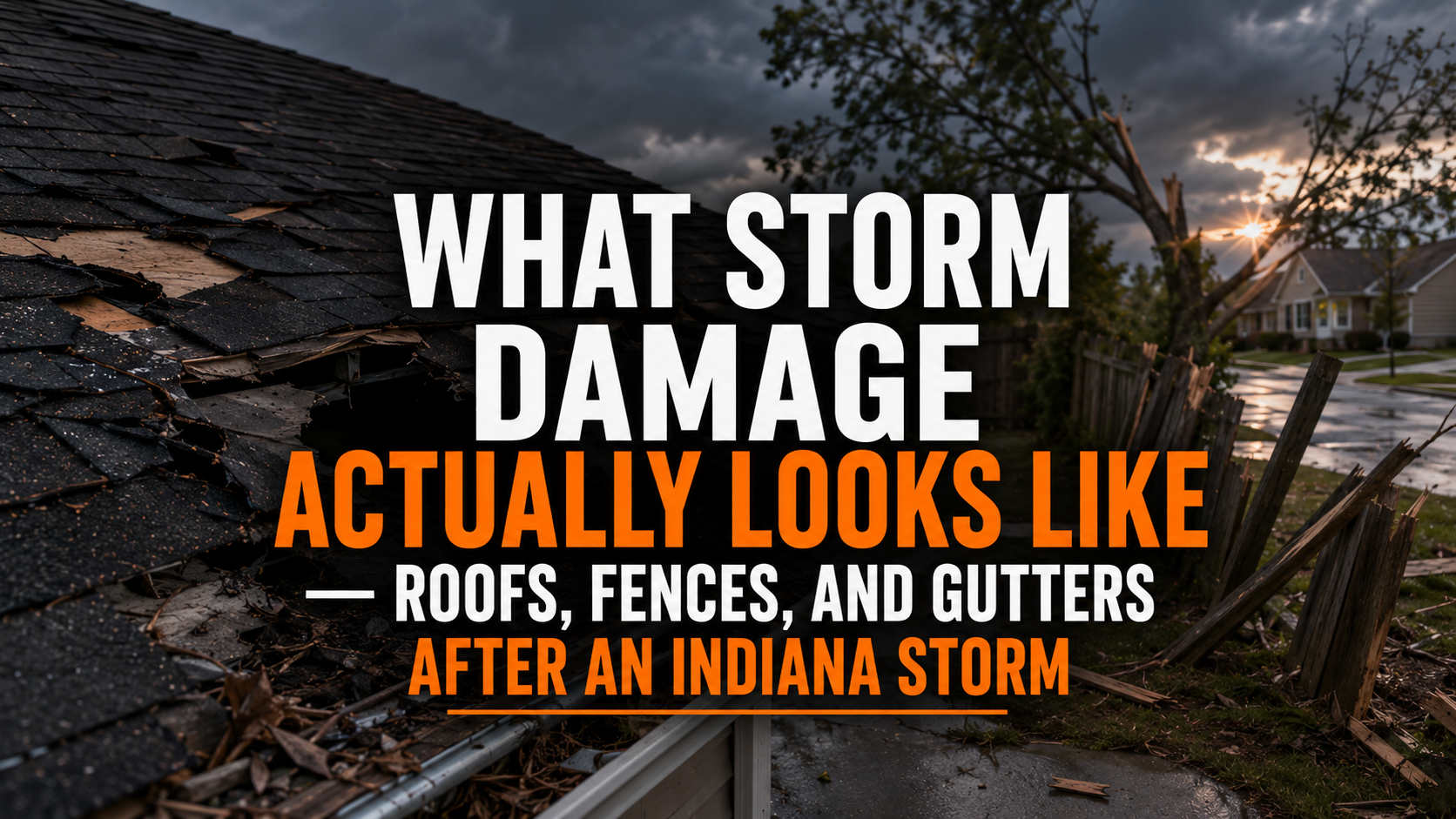
After a few days of rough weather this week, I want to write something different than the usual storm damage signs checklist. Here is what we are genuinely seeing right now when it comes to storm damage on roofs, fence, and gutters, what actually matters, and — just as important — what does not.
The Thing Nobody Tells You: Most Storm Damage Is Invisible From the Ground
Here is the uncomfortable truth that most contractors will not say out loud: if you can clearly see roof damage standing in your driveway, it is usually already serious. The storm damage signs that matters most — the kind that turns into a leak six months from now — almost never shows up to a homeowner looking up from the yard.
We inspected roofs in Terre Haute and Avon where the homeowner called because “it looks fine, I just wanted to be sure.” It was not fine. Hail had bruised about 30 percent of the shingle field on the north slope — granules knocked loose, the mat underneath compromised — and from the ground it looked like a completely ordinary roof. The homeowner two doors down with visibly missing shingles had less actual damage in terms of total roof life lost.
This is why we do not just look at a roof and make a call from the street. We get on it.
What Hail Damage on a Roof Actually Looks Like Up Close
Hail does not punch holes in shingles the way people picture. What it actually does is bruise them. Picture a soft impact dent — sometimes you can feel it more than see it, a slightly soft spot where the mat fiber underneath has fractured even though the surface granules are still mostly intact.
The reliable tell is granule loss in a pattern. Random wear looks scattered and inconsistent. Hail damage looks like someone took a handful of marbles and threw them at the roof from directly above — circular impact points, fairly evenly spaced, often more concentrated on one slope than another depending on wind direction during the storm. If you see that pattern repeated across multiple shingles in roughly the same size, that is hail, not age.
Soft metal is actually the fastest confirmation. Roof vents, the flashing around a chimney, gutter tops, AC unit fins — these dent from hail the same size that just bruises a shingle without leaving an obvious mark. If your gutters or vent caps have small dings in them, your shingles almost certainly took the same hit, even if they look okay.
What Wind Damage Looks Like — and Why It Is Easier to Spot Than Hail
Wind is more honest than hail. It either takes a shingle or it does not. What you are looking for is the edge — shingles that have lifted and not laid back down flat, a slightly raised tab that catches a shadow differently than the shingles around it. Once a shingle’s seal has broken from wind uplift, it does not reseal itself. It will keep flapping in every wind event after that until it eventually tears off or lets water under it.
The spots to check first are the ones that take the most pressure — roof edges, the ridge line, and anywhere two roof planes meet at an angle. We see more wind damage at hip and ridge caps than anywhere else on a roof, because those shingles are exposed on more sides.
If you had a storm with sustained wind over 40 mph, walk your yard line first. Shingle granules and small shingle fragments in the grass near your foundation are a much more reliable signal than anything you can see by looking up.
Fence Damage After a Storm — What We Actually Check
Fences get less attention than roofs after a storm, which is a mistake, because fence storm damage signs compound fast. A post that is leaning two inches after a wind event is not a cosmetic issue — it is a structural failure starting. The concrete footing has cracked or shifted, and every subsequent wind load makes it worse until the post eventually snaps at the base.
What we look for first is consistency. Walk the fence line and sight down it from one end. A fence that is uniformly slightly off vertical was probably installed that way and is not storm related. A fence with one or two posts noticeably out of line with the rest is showing you exactly where the storm did its work.
Privacy fence panels act like sails — that is the honest physics of it — so they take the most wind load of any fence style. Check the panels themselves for cracking at the point where the boards meet the rail, not just obvious missing boards. That stress point is where wood fences fail first and it is rarely visible unless you are looking for it specifically.
Gate hardware is the other thing people miss. A gate that used to close cleanly and now drags or will not latch is telling you the post it is hung on has moved, even if the post looks straight to the eye.
Gutters — The Most Underrated Storm Damage Indicator on Your Whole Property
If we only had one place to check for storm damage on a property, it would be the gutters, because they tell you what hit the roof better than the roof itself does in the first week or two after a storm.
Granule buildup in the gutter trough is the first thing. Pull a section of leaf guard or look directly into an open gutter — a fresh, heavy deposit of dark granules that was not there before the storm is direct evidence of impact on the roof above. We use this constantly during inspections because it is one of the most reliable confirmations available without climbing onto every section of roof.
Check the gutter itself for dents, not just what is inside it. Aluminum gutters dent easily from hail and the dent pattern tells you the relative size of the hail you got. A gutter pockmarked with small uniform dents had small hail. A few larger, deeper dents mean a few larger stones came through, which usually means more significant roof damage in those same areas even if the overall hail event was not severe.
Separated seams and pulled hangers are wind damage, not hail. After a high wind event check that the gutter is still pulled tight to the fascia along its full length — a section that has pulled away even an inch will not drain correctly and creates exactly the kind of water-against-the-foundation problem that turns into a much more expensive repair than the gutter itself.
Why We Tell People to Get an Inspection Even When Nothing Looks Wrong
This is the part most companies will not tell you honestly because it sounds like we are trying to manufacture business. We are not. The reality is that hail and wind damage genuinely does not announce itself. We have inspected roofs three separate times for homeowners who called us convinced everything was fine, and twice out of three times we found something — not always something that needed full replacement, sometimes just a section that needed repair before the next rain.
The inspection itself is free and it takes us about thirty minutes. We are not going to tell you that you need a new roof if you do not. We have turned down replacement jobs more than once this season because the storm damage signs genuinely did not warrant it — a fact our sales team will confirm is true even when it costs us the bigger job. That is the only way an inspection is actually worth anything to you.
What to Do If You Suspect Storm Damage Right Now
Document what you can see from the ground with your phone, including the gutters and any fence sections that look off. Do not climb onto the roof yourself — it is genuinely not worth the fall risk for an inspection that takes us thirty minutes with the right equipment.
Call your insurance company if you have visible damage or strong reason to suspect it, but get an independent inspection before the adjuster comes out if you can manage the timing. A written report from a roofing contractor — not affiliated with your insurance company — gives you something to compare against the adjuster’s assessment, and the two do not always agree on scope.
If it has been more than a week since the storm, check your gutters today even if you have already ruled out roof damage. It is the fastest five-minute check available and it will tell you more than another walk around the yard looking up.
We Are Out Doing These Inspections Now
Between this week’s storms and the ongoing summer storm season, our crews are actively inspecting roofs, fences, and gutters across Terre Haute and Avon right now for storm damage signs. If you want an honest answer about what your property actually has — not a sales pitch — call or text us and we will get someone out.
Call or text: (812) 234-2605 Schedule online: CallGuarantee.com Terre Haute: 1221 Hulman Street, Terre Haute, Indiana 47802 Avon: 8447 East US Highway 36, Avon, Indiana 46123
Guarantee Roofing and Fence has been doing this in Terre Haute and Avon since 1919. We will tell you the truth about what we find — even when that means there is nothing to sell you.